

14 Points from Genesis that emphasize male-female differentiation
What does it mean to be a man? What does it mean to be a woman?
While it seems that this discussion is a fruitless endeavor that results in people only stating their personal preferences, we do find an objective perspective given to us in the first three chapters of Genesis that demonstrate the essential equality of men and women while preserving male and female distinctives. Both Jesus and Paul found these opening chapters to be decisive in settling matters of marriage and gender (cf. Mark 10:5-9; Matt 19:1-9; 1 Cor 11:8-9; Eph 5:22-33; 1 Tim 2:12-15).
In the Beginning
There are many ways that men and women are different from one another, from their bodies to their brains to their roles. Sometimes complementarians can overemphasize the differences between men and women. We obviously share far more in common than we do differ. The overwhelming amount of Scripture applies the exact same way for both men and women. Both male and female are made in the image of God (Gen 1:26-27) and both given the great benediction in Genesis 1:28 to be fruitful, multiple, and to exercise dominion over the whole earth. And now, in Christ, being a man or woman gives us no advantage in righteousness (Gal 3:28). Thus, there is equality between the two.
But, there are a number of details in the Genesis account that point to some differences between the two. I will try to be brief in my comments, and just let the preponderance of the differences speak for themselves. More theology and synthesis is needed, but simply paying attention to the biblical data is a good place to start.
First, both male and female are made in the image of God, but the generic term for “human beings” is “man,” (אָדָם, adam). Ray Ortlund writes, “God did not name the human race ‘woman’…He does not even devise a neutral term like ‘persons.’ He called us ‘man,’ which anticipates the male headship brought out clearly in chapter two,” (Recovering Biblical Manhood and Womanhood, p. 98).
Second, Adam is formed first, and then Eve—a fact that Paul considers to be very significant for the life of the church and marriage. Paul teaches that only men are permitted to serve as teachers in the church and husbands are the head of their wives based on this (1 Tim 2:12-13; 1 Cor 11:3-10; cf. Eph 5:22-33). Being formed first does not equate to superiority, of course, since God forms fish and stars before forming mankind. If anything, the flow of Genesis 1 should lead us to believe that which is created last seems to have more significance, not less. And we are specifically told that it is the offspring of the Woman who will crush the head of the serpent (Gen 3:15). Adam being made first doesn’t mean he is better.
Third, Adam alone is commanded to “work and keep” the garden (Gen 2:15; cf. 2:5), language that is used elsewhere to describe the work of priests in the tabernacle/temple (Num 3:7-8; 8:26; 18:5-6). Thus, Adam is given a priestly responsibility to guard the holiness of the garden (and his soon-to-be bride) from serpentine usurpers. Kevin DeYoung points out that this role is tied to Adam’s priority in the creation order, “The order matters because it indicates Adam’s position in the creation narrative as priest and protector and Eve’s position as coming under the man’s protection, made from his side and for his support,” (Kevin DeYoung, Men and Women in the Church, p. 27).
Fourth, Adam alone is directly given the command to eat of every tree in the garden, except for the tree of the knowledge of good and evil (Gen 2:17). Nowhere in the text are we told that God instructs Eve. We are left to assume that Adam is responsible to teach his wife the command, which would make sense of why Paul grounds the prohibition against women teaching partially in Adam being made first (1 Tim 2:12-13).
Fifth, Adam alone names the animals of the earth (Gen 2:19)—a practical outworking of the “dominion” God has given mankind over “every living thing that moves on the earth” (Gen 1:28). That “dominion” is given to both men and women, but here we see Adam exercising a unique aspect of that leadership.
Sixth, Adam names and identifies woman (“Woman” in Gen 2:23, and “Eve” in 3:20). After Adam names the animals and no helper “suitable for him” is found, God creates Woman from the side of Adam. We are then told the first recorded words of man in Gen 2:23: “This at last is bone of my bones / and flesh of my flesh / she shall be called Woman / because she was taken out of Man.” Ray Ortlund explains, “God did not explain to the woman who she was in relation to the man, although He could have done so. He allowed Adam to define the woman, in keeping with Adam’s headship. Adam’s sovereign act not only arose out of his own sense of headship, it also made his headship clear to Eve. She found her own identity in relation to the man as his equal and helper by the man’s definition,” (Recovering Biblical Manhood and Womanhood, p. 102-03). Adam’s words show the great equality of Eve (she is my bone and flesh) while maintaining the distinction between them—Adam is the one who names her. Eve does not then turn around and name Adam.
Seventh, Eve is described as Adam’s “helper fit for him” (Gen 2:18). “Helper” may sound condescending to us, but it isn’t in Hebrew. The word is frequently used to describe God Himself, as in Psalm 115:9, “O Israel, trust in the Lord! He is their helpand their shield.” A helper is one who possesses a strength and ability that the one helped lacks. Adam cannot fulfill the command to “be fruitful and multiply” by himself, thus it is “not good” that man is alone (Gen 2:18). Woman possesses the generative power to create life that Adam by himself lacks. She is made from man and also for man: “For man was not made from woman, but woman from man. Neither was man created for woman, but woman for man,” (1 Cor 11:8-9). Again, this may sound strange to our ears, but Paul’s point is simply that Adam was created first, and then Eve.
Eighth, Adam and Eve are created differently. Adam is formed from the “dust of the earth” (Gen 2:7) while Eve is formed from the “side of man” (Gen 2:21-23). Their respective locations of creation poetically display their unique roles in the commission God has given them to “be fruitful and multiply,” (Gen 1:28) and to “work and keep” the garden of Eden (Gen 2:15). Within the framework of Genesis, this explains why men’s bodies and women’s bodies are fundamentally different. Adam’s body corresponds to the ground he must work. Eve’s body corresponds to the man whom she will “help” multiply (Gen 2:18). “The way in which each was created suggests the special work they will do in the wider world—the man in the establishment of the external world of industry, and the woman in the nurture of the inner world of the family that will come from her as helpmate,” (DeYoung, Men and Women, p. 29).
Ninth, a man is to “leave his father and mother and hold fast to his wife,” (Gen 2:24), becoming independent enough that he can create a new household to care for a wife. The same is not said of the wife—again, something Paul finds significant (Eph 5:31; cf. 1 Tim 5:8).
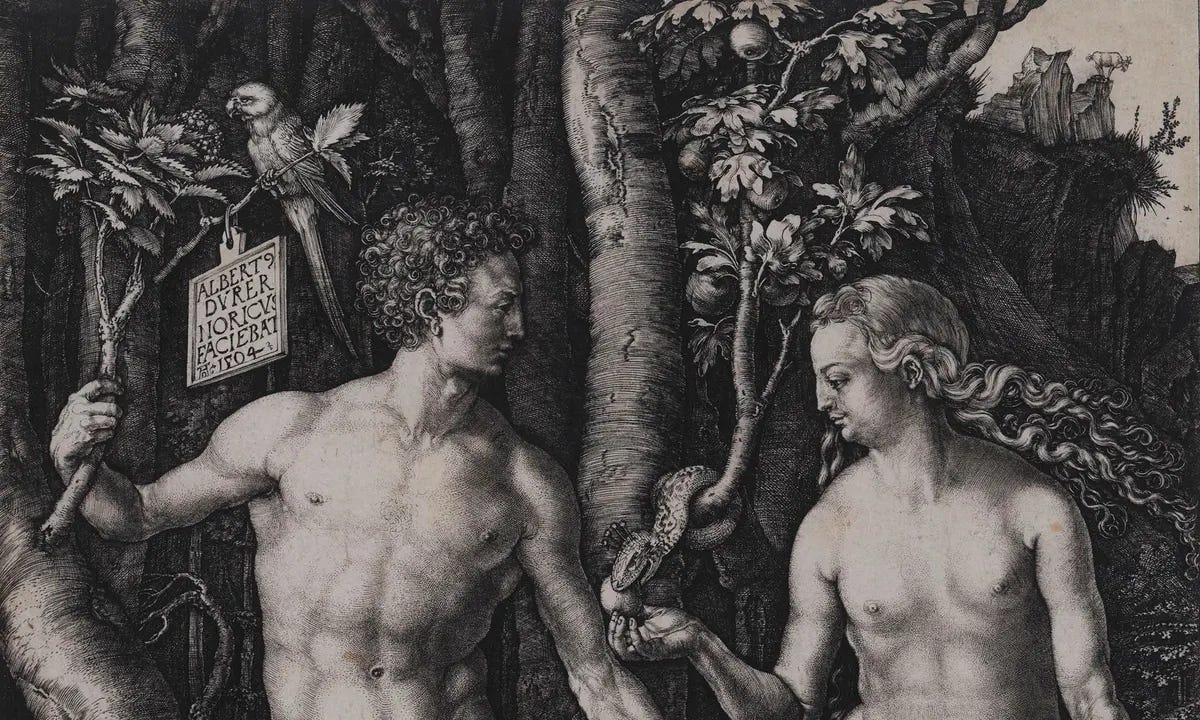
Tenth, the serpent focuses his deception upon Eve, not Adam. Eve was dependent on her husband for the teaching of Gen 2:16-17. In tempting Eve, the serpent was usurping the God-ordained authority structure. God had set Adam to be a generous, Christlike authority over Eve (Eph 5:31-32), and the husband and wife together were to be generous, godly authorities over the creatures and earth (Man—>Woman—>Creatures). Genesis 3 presents a precise reversal of that. A beast of the field commanding the Woman who then commands the Man (Creature—>Woman—>Man). We see God set this disorder right by dealing with the subjects in the appropriate order. The deception went: Serpent—> Woman—>Man, so God first judges the serpent (Gen 3:15), the woman (Gen 3:16), and then the man (Gen 3:17-19). We see this further emphasized in the fact that we are specifically told that Eve “gave some” of the forbidden fruit to her husband who was “with her” (Gen 3:6). We are not told that Adam was equally active in seeking the fruit as Eve is. Eve initiates the act. This does not, of course, in any away absolve Adam of guilt. Adam was “with her” but was passively sitting by and when Eve took initiative and led Adam through the offer of the fruit, he abdicated his priestly leadership. Paul, again, finds this disordered deception of important significance: “Adam was not deceived, but the woman was deceived and became a transgressor,” (1 Tim 2:14). Again, that doesn’t absolve Adam of guilt in anyway. If anything, it makes things worse for Adam—he wasn’t even deceived, and yet still ate the fruit. Paul’s point here is that the God’s flow of authority was upended when Eve was deceived by the serpent and then exercised her authority over Adam.
Eleventh, Adam appears to bear a special responsibility for the Fall. It is only after Adam eats the fruit that we are then told that the eyes of both are opened and aware that they are “naked” and hide (Gen 3:7)—the exact reversal of Gen 2:25. When God arrives He only calls out for Adam (Gen 3:9), despite knowing that both the husband and wife are in hiding (Gen 3:8). Further, Adam’s curse is three times as long as Eve’s. Remember, God only told Adam specifically that he would die if he ate the fruit, but Eve dies as well. Why then did God pronounce the judgment of death only to Adam? Because Adam’s role as the head of the human race and head of his marriage bore consequences for all those under him. This is Paul’s reasoning when he speaks of Adam alone as being responsible in Romans 5:12-21. Adam was the priestly overseer of the garden. He was supposed to guard its purity and protect his wife, but he failed.
Twelfth, when the curse of sin falls on the man and woman, it bruises the distinct locations Adam and Eve were created from: the dust of the earth and the side of man. Adam, who had been tasked with “working and keeping” the garden finds that his labor is now cursed with toil and thorns till he collapses back into the dust (Gen 3:17-19). Eve, who had been tasked with helping Adam fulfill his vocation of filling the earth is now beset with pain in childbearing and enmity between her and the man (Gen 3:16). The man is cursed in the domain of work, while the woman is cursed in the domain of relationship. The man finds the external world of cultivation beset with frustration, the woman finds the internal world of family riddled with strife and pain.
Thirteenth, Eve’s curse emphasizes pain in childbearing and a desire to dominate her husband (Gen 3:16; cf. Gen 4:7). The concluding aspect of the curse, that the man will “rule over you” could mean two things. One, it could be a beneficent, Christ-like rule that is meant to lovingly correct the dominating desire the Woman will have to rule her husband. Or, (more likely) it could be a cruel, tyrannical kind of response to her dominating desire that looks nothing like Christ. Either way, feminist scholars who seek to charge that male-headship begins here with the curse (and is thus removed in Christ) fail to reckon with all of the other pre-Fall evidence for Adam’s headship over Eve or give satisfying explanations of all of Paul’s arguments.
Fourteenth, when God curses Adam he does not say, “Because you have eaten of the tree,” but instead says, “Because you have listened to the voice of your wife and have eaten of the tree,” (Gen 3:17). We may be spring loaded by our culture to assume that it sounds inherently misogynistic to criticize a man for “listening to the voice of his wife,” but we must be able to calmly consider what God is saying before pre-judging. The exact problem, of course, in Genesis 3 is that Adam listened to the voice of his wife at the expense of heeding God’s voice. “Because you listened to the voice of your wife and have eaten of the tree which I commanded you, “You shall not eat,” (Gen 3:17). Adam had two competing voices he could listen to, and he chose his wife over God’s. Again, as the priest-king, Adam was responsible for leading Eve to similarly heed God’s voice and not listen to the serpent. But, instead, Adam listens to the words of the serpent that are now coming from his wife. This is a subtle motif picked up again in the story of Abram and Sarai when they fail to believe God’s promise and Sarai commands Abram to sleep with her servant Hagar to bear a child, “And Abram listened to the voice of Sarai,” (Gen 16:2).
Conclusion
There is much more that must be said. What does it practically look like to translate this into a marriage or church today? What are the limits of authority and headship? If you are interested, I would strongly recommend picking up Kevin DeYoung’s brief book Men and Women in the Church and reading his chapter on Genesis 1-3. But, maybe it would be helpful to end by considering what Paul thinks this will practically look like in a marriage:
Wives, submit to your own husbands, as to the Lord. For the husband is the head of the wife even as Christ is the head of the church, his body, and is himself its Savior. Now as the church submits to Christ, so also wives should submit in everything to their husbands. Husbands, love your wives, as Christ loved the church and gave himself up for her, that he might sanctify her, having cleansed her by the washing of water with the word, so that he might present the church to himself in splendor, without spot or wrinkle or any such thing, that she might be holy and without blemish. In the same way husbands should love their wives as their own bodies. He who loves his wife loves himself. For no one ever hated his own flesh, but nourishes and cherishes it, just as Christ does the church, because we are members of his body. “Therefore a man shall leave his father and mother and hold fast to his wife, and the two shall become one flesh.” This mystery is profound, and I am saying that it refers to Christ and the church. However, let each one of you love his wife as himself, and let the wife see that she respects her husband. (Eph 5:22-33)
If the blueprint for headship-submission in marriage is Jesus Christ’s love for His Church, then the last thing headship and submission should look like is exploitation or abuse. It should look like sacrifice, self-denial, cherishing, provision, and spiritual care.

 Marc Sims