

When I was 9 years old, my Dad went out and bought a surround-sound system and a DVD player. I remember my mom being angry he had spent the money, but the kids all gathered around it like the treasure of El Dorado. My siblings and I had heard of such technology, but assumed only rich people had it. You don’t have to rewind the movie once it’s done?! Our 27-inch tube-television didn’t necessarily give us the clearest picture in the world, but we didn’t know that. We all jealously huddled close to behold this cutting-edge technology; the best movie-viewing experience money could buy. The first digital video disc I ever saw was the 1998 cheese-fest, Godzilla, a genuinely awful movie. It currently has a 20% on Rotten Tomatoes. The junior-high tagline for the movie, “Size Does Matter,” tells you about all you need to know. Roger Ebert wrote: “One must carefully repress intelligent thought while watching such a film.”
But I was nine, so repressing intelligent thought came rather naturally. I was in awe of the sheer immensity of Godzilla, and was probably just excited that I was viewing it via this new medium of technology. I could hear the lizard king’s roar coming at me from every angle. What more could I ask for?
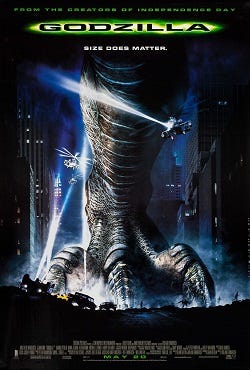
Well, I could ask for quite a bit more: better acting, a better script, a compelling narrative that pays the audience the respect of assuming they won’t be entertained by cheap CGI special effects void of any substance. But, the newest installment in the monster franchise, Godzilla Minus One, offers all of that in spades.
The story is set in post-WWII Japan, following a failed Kamikaze pilot who now lives in perpetual survivor’s guilt. He returns to a home that has been reduced to small piles of rubble and the communal shame of a deserter. Immediately he meets another impoverished survivor, a woman who has pledged to care for an infant who is not her own. The man reluctantly takes the woman and child in, and together they work to scrape together the barest means of survival so that the child will not starve to death. Their life, the entire nation, seems to hold together by the barest of threads. And into this smoking desolation of human ruin, an irate 164,000 ton dinosaur shows up.

It is a good film (97% on Rotten Tomatoes), with a few quirks here and there. But what it excels at is underlining what all good Godzilla movies underline: human weakness in the face of chaos. Or, to put in the words of Job, “Behold, the hope of a man is false; he is laid low even at the sight of [Leviathan],” (Job 41:9).
Godzilla and Leviathan
In the book of Job, when the Almighty is dressing Job down, He asks Job to consider the sea-monster, Leviathan: “Can you draw out Leviathan with a fishhook or press down his tongue with a cord? Can you put a rope in his nose or pierce his jaw with a hook?…Lay your hands on him; remember the battle—you will not do it again!” (Job 41:1-2, 8). For the whole of chapter 41, God describes the terror and immensity of this sea-monster, from the power of his limbs, to the impervious scales of his armor, to the fire that comes from his mouth—fire so considerable that he can make the entire sea boil! (Job 41:31). Obviously, God here appears to be describing an animal that seems to exist only in the realm of myth and legend.
Strangely, this sea-dragon is frequently referred to throughout the Bible. He represents the forces of primordial chaos, the fear of what is hidden in the dark forest at our back, the panic you feel when swimming in a large body of water and the sudden thought of what is below me? grips you. It is the fear of an inhumane malevolence that exists only to unravel and abolish all that is good and orderly, to suck you down into a hostile environment before ripping you to shreds. In the story of the Bible, the Leviathan is used to represent the ultimate serpentine enemy, Satan himself (Rev 12). Seriously, go back and click on that link above, the Bible Project does a great job of creatively explaining this theme.
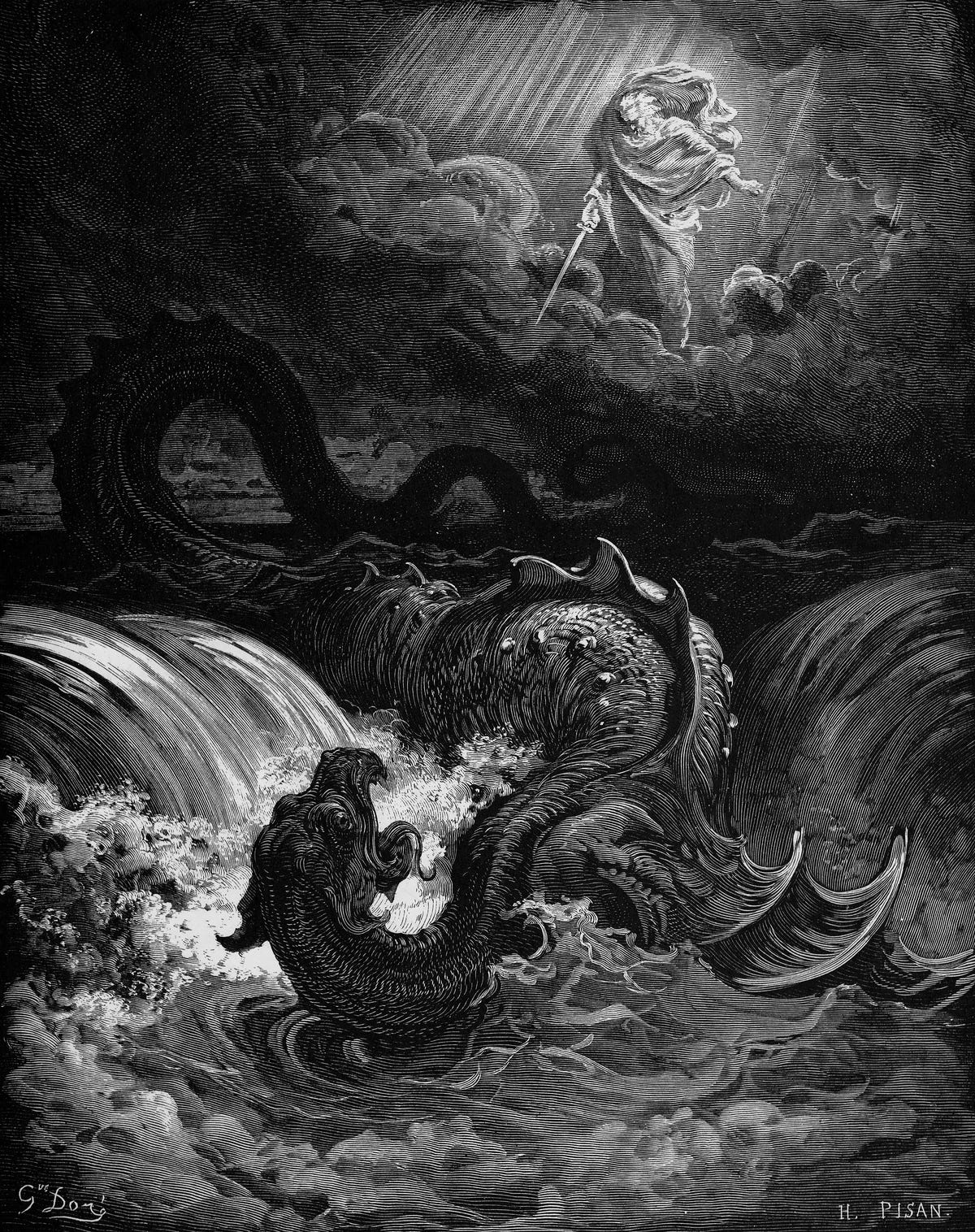
Godzilla appears to be our current culture’s recycling of these themes: a fire-breathing, sea-dwelling, lizard-monster that is immune to all human weapons and technology. God repeatedly asks Job whether any weapon or tool will suffice to control Leviathan: “Though the sword reaches him, it does not avail, nor the spear, the dart, or the javelin,” (Job 41:26).
Godzilla is an unstoppable force. The ominous *thump* *thump* *thump* of his feet never slow, never divert. Bullets, bombs, and battleships do nothing. They may as well be gnats landing on the back of a crocodile. “The arrow cannot make him flee; for him, sling stones are turned to stubble. Clubs are counted as stubble; he laughs at the rattle of javelins,” (Job 41:28-29).
The classic trope of a monster plowing through cities, crumpling buildings while bullets harmlessly plink off its hide, may be enduring because of just how humbling the image is. There are few greater testaments to human technology and ingenuity than the skyscraper and the gun. Both represent the height of man’s technological prowess, the desire to erect an edifice or wield a weapon that reminds us of our power, that, in fact, extend our power beyond what is naturally capable to us. We can defy the limits of nature by mastering her and erecting a city. We can defy our human frailty by picking up a gun and using it to far greater effect than our bare hands ever could. They give us a sense of security, of vanity, of self-importance. Though they are typically modern symbols, they are no different than the Tower of Babel, than the war-horse, and the iron sword of Job’s day.
There is something perversely interesting, therefore, in watching some ancient creature arise out of the crypts of the deep, moss-covered and murky, to annihilate the gleaming cities of steel and glass; to see men vainly reach for weapons that are as effective as vapor and smoke against the colossus coming their way. Watching Godzilla reminds us of just how frail and impotent we really are.
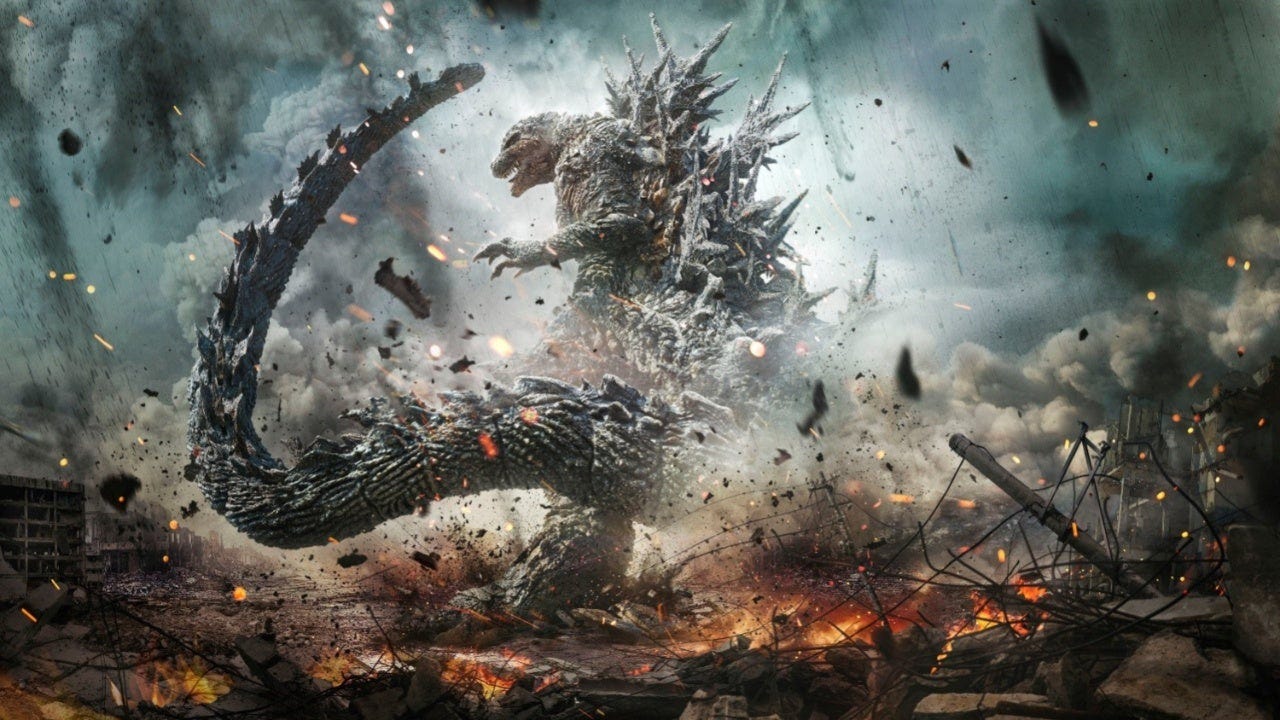
In many Godzilla movies, he is either awakened or attacked by a nuclear bomb. Many people have pointed out that Godzilla simply stands as a symbol of nuclear warfare in general, a force once awakened that is as likely to be contained as…well, as Godzilla. I think the resonance of Godzillas and Leviathans and Dragons, however, is more broad than that. Like Isengard being pillaged by the Ents, it is a reminder that the intoxicating allure of technology and its promise of invincibility is a fool’s bargain. Technology may ameliorate many of the problems of life, it may even give us DVD players and sound-systems that convince children that bad movies are better than they are. We may slowly grow in our mastery over nature, but we will never have her licked. In fact, often it is our employ of technology that brings about devastation and death on a scale that nature rarely ever exacts. In Godzilla Minus One, as the hero first walks through a bombed-out Japan, it looks like Godzilla already has done his worst. But he hasn’t. Airplanes and napalm have done his work for him.
The Humiliation of a Monster
Why does God want us to consider Leviathan? When God asks Job, “Can you draw out Leviathan with a fishhook?” the assumed answer is, of course, No. We are weak and the world is full of powers and forces beyond our control, even with the tools of fishhooks, harpoons, and javelins at our disposal. “Behold, the hope of a man is false; he is laid low even at the sight of him. No one is so fierce that he dares to stir him up,” (Job 41:9-10a). God wants to puncture human pretension: the hope of a man (technology) is false. But then God asks this: “Who then is he who can stand before me? Who has first given to me, that I should repay him? Whatever is under the whole heaven is mine.” (Job 41:10b-11).
In other words, if Leviathan is this terrifying, and you are this powerless before him…and he belongs to me—I made him, then what am I like?
If the Almighty is the One who flings hurricanes and blackholes and galaxies into creation, if He summons the uncontrollable forces of chaos and reigns over them, if He crushes the dragon head under His mighty foot, then what is He like? If He is to Leviathan in power and strength what Leviathan feels like to us, if we tremble before Leviathan, what then should we do when we come before Him?
Here is how Job responded:
“I had heard of you by the hearing of the ear, but now my eye sees you; therefore I despise myself, and repent in dust and ashes.” (Job 42:5-6)
I don’t think God intends to send giant monsters to wipe metropolises off the map. But I do think the point of God’s exposition of Leviathan is this: be humble, mankind. The God you take for granted is far grander, far more powerful than you could ever imagine. And the technology that often gives you the illusion of power is far weaker than you could ever dream.

 Marc Sims